psoriasis, Psoriasis Treatments

3 Weeks with Tremfya: The Waiting Game

The beach at Point Montara Lighthouse (south of San Francisco) proved a wonderful and peaceful spot to spend Labor Day Sunday and Monday with a church group.

Are we there yet? It’s a question every parent has heard asked by a child in a long line or road trip. After three weeks on Tremfya (Guselkumab) I know I shouldn’t be asking the question, but I’m anxious to know when I might find clearer skin. It’s a waiting game that I feel like I’m losing.

I don’t have exact data on when people’s psoriasis started responding to Tremfya. During Phase II trials one paper mentioned patients saw response by the four week check-up. But my dermatologist agrees with the charts I’ve seen where many people respond after the second injection at week 4.

When Will Tremfya Start Working?

In my quest to understand more about how long I might need to wait, I began reading about medication half-life, loading doses, and steady-state concentrations. I seriously want to talk to a pharmacist or a doctor who can explain pharmacokinetics to me. Or I need the pharmacokinetics for dummies book if one’s available.

What I gathered is that it takes 5-7 half-lives for a medication to build up to the desired concentration (steady-state) in the body. I always thought of half-life in terms of degradation, i.e., the time it takes for something to degrade by half (then another half from there). You know, as in carbon or radioactive dating, But apparently there is also a half-life for the concentration of a medication to build up in the body.

—————–

What I gathered is that it takes 5-7 half-lives for a medication to build up to the desired concentration (steady-state) in the body.

—————–

Tremfya’s mean half-life is 15-18 days. With taking the average of the mean (okay I’m just going to use 16.5 days for the sake of argument) 5-7 half-lives would be about 83 (12 weeks) to 116 days (16.5 weeks). The extra dose at week 4 adds another factor I’m not sure how to calculate, but speeds up the process. Another factor, I’m reminded by my pharmacist today, is the time it takes the medication to calm the inflammation on my skin even after reaching steady-state levels in my body.

So, when the charts show the majority of people’s psoriasis responding between 4 and 12 weeks, that matches with my super rudimentary, untrained calculations and what clinical trials show.

I wish today were week 4 (upcoming Monday) so I could take that second injection. Unfortunately, I’m just a couple days past week 3. Are we there yet?

—————–

Follow my Tremfya journey

Tremfya (Guselkumab) Week One

5 Weeks with Tremfya: Biggest Fear?

6 Weeks with Tremfya: Redefining Expectations

8 Weeks with Tremfya: It’s Working!

10 Weeks with Tremfya: One Step Back

12 Weeks with Tremfya: The Third Injection

14 Weeks with Tremfya: What’s Next?

16 Weeks with Tremfya: The Verdict?

20 Weeks with Tremfya: Read the Instructions! (4th Injection)

24 Weeks with Tremfya: A Pattern Emerges

28 Weeks with Tremfya: Still Working? (Injection #5)

38 Weeks with Tremfya: The Question/Answer Edition

42 Weeks with Tremfya: Coping with a Skin Flare

—————–

Two Weeks with Tremfya on Labor Day

I marked two weeks on Tremfya on Labor Day last Monday. The second week on the new medication felt uneventful psoriasis wise. I thought I started seeing some response to the medication on my stomach and back about ten days into the treatment, but those spots returned a few days later. At the same time, my forearms and lower legs do look more clear of psoriasis.

A few more psoriasis spots popped during the third week as well. But I stopped Enbrel (etanercept) over three weeks ago. It’s possible I’m experiencing a psoriasis rebound from discontinuing Enbrel and lowering my cyclosporine dose.

While I can’t say for certain that Tremfya caused me to feel tired or ill, the second week I continued to feel tired and ill. I slept more than normal. I took asthma rescue puffs into my lungs more than usual. Periodic headaches came and went like the tide. But by the Labor Day weekend I started feeling better. I wonder if those symptoms will return after taking the week 4 dose?

During the third week I started running and walking regularly again despite the California Central Valley heat and periodic smoky air due to wild fires. I love running, and knowing I’m doing something positively good for my health motivates me to keep going in under less than ideal environments.

The Stress Factor

Another reason I might still be waiting for my psoriasis to respond to Tremfya is added stress. That second week I went to meetings or gatherings five out of seven nights. I also scrambled to meet a couple blog deadlines, one of which I ended up missing. I don’t miss deadlines, so when I do I feel behind and STRESSED.

That second week marked the end or psoriasis awareness/action month. To commemorate the month I took the opportunity to speak at a biotechnology company in the Bay Area called Dermira. They asked me to share my psoriasis journey with them during their lunch time staff meeting. A lot more people packed the room than I imagined would attend. That day we drove five hours and spent two hours at the company. Awesome day, but stressful and tiring.

—————–

Therefore do not worry about tomorrow, for tomorrow will worry about itself. Each day has enough trouble of its own.

—————–

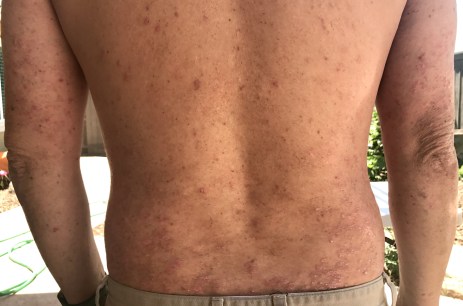
My skin gave me the angry looks of red, irritated lesions that emerge during stressful times.

The Guessing Continues

The waiting game is also a guessing game. This blog confirms that I think about what’s happening with psoriasis ALL THE TIME. I try to read the skin “tea leaves,” but only God truly knows what’s going on with my complex immune system. Only he knows what’s going to happen at week 4 and beyond.

I’m reminded of what Jesus said as he taught his followers: Therefore do not worry about tomorrow, for tomorrow will worry about itself. Each day has enough trouble of its own. (Matthew 6:34). I have lots to manage today, so I better get to it. Staying in the moment helps me pass the time anyhow while waitng for those half-lives.

Standard
psoriasis, Psoriasis Treatments

Tremfya (Guselkumab) Week One

One week ago, I started taking Tremfya (guselkumab) for my psoriasis. The journey to taking that injection started months ago when I talked to my dermatologist about it. I then learned a lot more about its efficacy and safety at the American Academy of Dermatology meeting in Orlando in March.

I’m a bit stunned that I’ve already taken my first dose.

—————–

Follow my Tremfya journey

3 Weeks with Tremfya: The Waiting Game

5 Weeks with Tremfya: Biggest Fear?

6 Weeks with Tremfya: Redefining Expectations

8 Weeks with Tremfya: It’s Working!

10 Weeks with Tremfya: One Step Back

12 Weeks with Tremfya: The Third Injection

14 Weeks with Tremfya: What’s Next?

16 Weeks with Tremfya: The Verdict?

20 Weeks with Tremfya: Read the Instructions! (4th Injection)

24 Weeks with Tremfya: A Pattern Emerges

28 Weeks with Tremfya: Still Working? (Injection #5)

38 Weeks with Tremfya: The Question/Answer Edition

42 Weeks with Tremfya: Coping with a Skin Flare

—————–

Tremfya Approvals

Tremfya received FDA approval in mid-July. I made a drop-in over lunch appointment with my dermatologist to get my prescription two weeks after. He prescribed it to me, but nothing happened for at least a week. I figured insurance held it up again, but turned out the medication hadn’t entered the pharmacy’s computer system.

After another two weeks passed I received a call from the UC Davis Health specialty pharmacy. I couldn’t believe insurance approved my taking Tremfya! They would ship it in a cooler pack on a Friday. I made an appointment the next Monday with the RN at the UC Davis Dermatology clinic to get training before injecting the first dose.

Pharmacist Counseling

I appreciated the pharmacist from the specialty pharmacy going over all the pertinent details and preparing me for what to expect. Tremfya would be my first new biologic for a few years as I settled in with Enbrel (etanercept) even though it wasn’t as effective as I wanted.

First, she told me to continue taking cyclosporine until I saw my dermatologist next. Enbrel I would stop on the Thursday before the first dose.

Tremfya is injected with a pre-filled syringe with about 1 ml of fluid and a small half inch needle for the 100mg dose. I thought it would come with an injection pen like Enbrel, but not so. I have quite a bit experience with syringes from Enbrel pre-injection pen days. The dosing schedule is week zero, week four, then every eight weeks thereafter.

Next, I learned of some the potential side effects of Tremfya, such as headache, upper respiratory infection/colds, and injection site reactions. I felt relieved to know that patients generally tolerated the medication well, with no black box warnings on the insert.

FullSizeRender.jpg-4

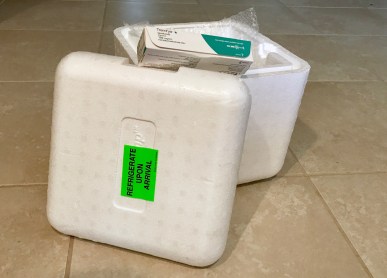
As scheduled the Tremfya arrived in a box, which was in a box with a cooler in it. My daughter signed for the delivery. The label said that one dose cost $9995. Thank God for insurance, however much I might complain about them.

First Tremfya Dose

As Monday approached the excitement and anxiety for the first injection ramped up. My wife drove me to the dermatology clinic about thirty minutes from home in Sacramento. The appointment coincided with the solar eclipse, which I enjoyed through a hole in cereal box as we drove east.

I couldn’t sit still as we waited for the nurse to call me back. Questions raced through my mind: Would Tremfya work for me? Would I have an adverse reaction to it? Would the needle hurt going in? Would the syringe be difficult to use?

The nurse finally called me to a room where we set up the injection. She had a Tremfya training syringe ready for me to practice first without a needle. In the meantime, we allowed the medication to warm up to room temperature to minimize any pain I might experience from the injection.

Then the nurse taught me how to swirl the alcohol wipe from the inside out. She told me to inject in my thigh, but I felt more comfortable injecting in my stomach. She instructed me to sterilize a larger area so I wouldn’t worry about finding the exact site on my stomach.

IMG_7854

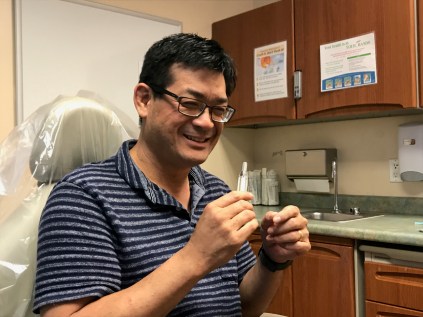
I practiced with an empty Tremfya syringe with no needle before injecting the real thing.

The springs on the syringe felt different than the Enbrel where I needed to pull the medication into the syringe and push out bubbles. I pinched a portion of my stomach then injected it smoothly in.  I pushed down the plunger slowly as she counted down from ten—twice. Once I finished the injection the needle sprung back as the plunger locked in place.

No pain. No blood. Easy. It took less than a minute for that first dose to get in my system just under my skin (subcutaneously).

For the next hour, I sat in the surgical dermatology waiting room as the nurse checked on me every fifteen minutes. I felt some light headedness, headache, and blurry vision—not sure if the medication, the anxiety of the buildup to the injection, or lack of food ultimately caused me to feel that way.

One Week After Taking Tremfya

During the next week, I checked my skin nervously to look for any changes. After some research, and talking to my doctor, I learned that I probably would not see any good response with my psoriasis for at least a few weeks with response rates starting to plateau around ten weeks (though still increasing for some weeks after).

Through more reading, I did learn that the half-life of Tremfya is about 15-18 days, and that the peak concentration would be about 5.5 days. I also found a paper in the New England Journal of Medicine on phase 2 trial data with a chart showing the response rate of those in the trial. The response rate of the phase 3 trials I found soon after looked closely aligned to the phase 2 trials.

During the week, I did feel a bit more tired, and possibly catching a cold with a slight sore throat. But I can’t say for certain it is the medication causing these symptoms. So far, the eczema rashes I fear emerging as they did with a previous biologic haven’t. Knock on wood. The immune system is so complex.

My next injection is in three weeks. I’m looking forward to hopefully sharing good news about my experience with guselkumab.

Standard
psoriasis, Psoriasis Treatments

Finding the Right Moisturizer for Psoriasis & Eczema

[This article originally posted on The Itch to Beat Psoriasis, Everyday Health on July 7, 2017.  In the article I did not mention any products. Here I’ll say that the moisturizers I use currently are CereVe Moisturizing Cream, Cetaphil Moisturizing Cream, Eucerin Creme, and Aquaphor Ointment. My use is not a product endorsement, but could be ideas to get you started if you’re looking to try something new.] 

I didn’t grasp the importance of using moisturizers on my dry skin until my mid-thirties. Back then I broke all the rules. I used my lotions and creams intermittently, not routinely. I took two showers a day, which I later learned was stripping my skin of natural oils. At every clinic appointment, my dermatologist noted the parched, dry desert that was my skin. I ignored his pleas for me to moisturize my skin.

Then I endured the worst stretch of skin health in my life. Psoriasis covered more than 95 percent of my body, and I was overwhelmed by feelings of depression. My dermatologist referred me to the Psoriasis Treatment Center at the University of California in San Francisco.

One nurse told me that their patients moisturize every two hours. I just nodded my head in agreement, not mentioning how my lotions and creams sit idle most days. Even though I didn’t end up receiving treatment there, I learned a valuable lesson that stays with me to this day: Moisturize your skin regularly.

Why Moisturize?

Since I have both psoriasis and eczema, I have double the reason to moisturize my skin.

On its website, the National Psoriasis Foundation (NPF) states that “keeping the skin lubricated on a daily basis is an important part of psoriasis care because it reduces redness and itching and helps the skin heal.”

Vivian Shi, MD, assistant professor of dermatology and director of the Eczema and Skin Barrier Clinic at The University of Arizona in Tuscon, has written that moisturizers work by “directly hydrating the skin,” and “bolstering the skin barrier to prevent the skin from losing water.”

I first met Dr. Shi when she was a resident at the University of California in Davis dermatology clinic in Sacramento, and I came to know her work better when I volunteered for an eczema study she conducted. I enjoyed catching up with her over the phone recently about skin moisturizers. On the call, she reinforced the importance of finding an effective moisturizer, as well as adhering to a skin moisturizing plan.

Narrowing Your Search

I asked Shi what was the right moisturizer to use on my skin. “Find the one that you will use,” she says. “At the end of the day, you have to pick one that you will use.” She cautioned me to avoid parabens, dyes, fragrances, and other allergens since I have sensitive skin.

Skin-care products dominate entire stores shelves. so how do you narrow your search for a moisturizer? One way is to look for stamps of approval from organizations such as the National Eczema Association (NEA). I also read articles like the NPF’s blog post, 10 Must-Have Lotions for Under $10, to get ideas. Physicians will often provide free samples to try at home, and I also enjoy sharing moisturizer and treatment ideas with friends and acquaintances.

Part of searching for a moisturizer is learning more about them. For example, Shi’s article taught me the difference between “fragrance-free” (no substances are used to impart an odor) and “unscented” (the product may have a fragrance that’s masked by another substance). She recommends fragrance-free products.

What about the difference between ointment, cream, and lotion? Ointments are the thickest moisturizers and do a great job of preventing water loss. Creams are less greasy than ointments, as they mix greases with a liquid, such as water. But according to the NEA, creams may “contain stabilizers and preservatives to prevent separation of their main ingredients, and these additives can cause skin irritation or even allergic reactions for some people.” Shi notes that lotions contain more liquid or water than grease. Since this liquid evaporates quickly, lotions generally don’t moisturize dry skin as well as ointments and creams.

I’ve used many ointments and creams over the years. Personally, I don’t mind a moisturizer that’s greasier, but I don’t like the feel of something like pure petroleum jelly. I tolerate thicker creams best. Cost and availability are also considerations. By weighing my needs and preferences, I’ve settled on products that I will use routinely.

Developing a Routine

Finding the right moisturizer is only half the battle. As Shi says, “the moisturizer is only good when applied on the skin.” I can certainly relate when she says that about 50 percent of people forget their doctor’s moisturizing directions as soon as they leave the office.

Over the last decade, I’ve refined a routine that works for my skin and lifestyle — a process that begins with a discussion with my doctor about my skin needs. I set aside time to moisturize at least twice a day. After I shower at night, I apply moisturizing cream within minutes of patting my skin dry. Then I apply topical prescription medication on affected skin lesions. When the weather is dry, I apply another layer of moisturizer after the topical medication.

I have the same routine in the morning, but without the shower. And keeping moisturizers in my backpack and at the office gives me the opportunity to moisturize outside of my two regular times if I feel the need.

Your routine will no doubt vary from mine. Some people, for example, set alarms on their phones to remind them to moisturize. Whatever you decide, stick to a routine that works. If you need to, modify your routine so that the moisturizers you’ve carefully chosen and paid for don’t sit idly on the shelf.

Standard
psoriasis, Psoriasis Treatments

9 Weeks Done with Otezla. Keep Going?

Note: below includes a picture of the current condition of my psoriasis on my back and arms. 

I’m entering the time when I expect to see more results from Otezla at two months. I started this new-to-me medication on May 15th for my psoriasis, and hopefully eczema. Unfortunately, instead of improving, I feel more and more inflammation on my skin than I have in a long time.

I had a great exchange with my dermatologist about Otezla. His response when I mentioned Otezla in the conversation?

🙄

I’ve known all along it’s not his favorite medication. Still, I’m hoping that it kicks in soon so I don’t have to switch medications again.

FullSizeRender

My lower back and upper arms are particularly broken out as I taper off from cyclosporine and enter my 3rd month on Otezla.

Tapering Cyclosporine

I’m not sure how much to temper my expectations since I also started tapering from Neoral (cyclosporine).

Neoral is a strong immunosuppressor. So, I’m not surprised it works so well for both conditions. I wouldn’t say I’m addicted to it, although I do like how much it keeps both psoriasis and eczema under control with relatively few noticable side effects. It’s hard to stop taking it for that reason.

This drug scares a lot of people, rightly so, as it comes with a long list of advserse effects, including kidney damage and hypertension. My body, though. tolerates it well. I’ve taken cyclosporine off and on for some years. The dermatologists allow me to go back on it after breaks partly because my labs come back mostly normal each time and it works for me. I’m sad to see it go.

Red Light, Green Light?

Stopping Otezla is also a difficult decision, but for another reason. What if it’s just days or a couple weeks away from reducing all this inflammation? I suffered the side effects for weeks and only recently do I feel they are not so severe. What if I persevered through all that insomnia, diarrhea, headache, and lost productivity for nothing?

If I don’t start something else soon, though, I could be covered in redness in a matter of weeks. If I do start another new medication, such as guselkumab that was FDA approved days ago, will that one work? How long might it take?

I’m not sure if I should give Otezla the red light or green light–even if only for a few more weeks.

It’s time to message my dermatologist again to see what he thinks I should do next if my condition doesn’t improve soon–although I already know what he thinks of Otezla. 🙄


Standard