psoriasis, Psoriasis Treatments

Denied! Insurance rejects appeals for Home Phototherapy

I am getting tired and frustrated with my health insurance provider. Really.

On December 15, 2017 my dermatologist, Dr. Maverakis, prescribed a home narrowband Uphototherapy unit. This unit, costing about five-thousand dollars, would treat both my psoriasis and atopic dermatitis (eczema).

With changing medical providers on January 1, I waited until I could see my new dermatologist. After almost missing the appointment, she agreed to submit the application that Dr. Maverakis started a couple months prior.

Surprise! not too long after I received the response from Western Health Advantage, my church’s health insurance provider.

First Insurance Denial

IMG_8668

Here’s an excerpt from the letter:

“The requested service, Home UV Photo therapy booth is being denied by Western Health Advantage (WHA) because it is currently considered Experimental/Investigational for a diagnosis of Psoriasis/Atopic Neurodermatitis. . . . and not a covered benefit under your health insurance plan.”

I couldn’t believe that WHA called home phototherapy “Experimental/Investigational” when I had used it effectively for many years earlier in life. I felt pessimistic about winning an appeal given how their reasoning, and how onerous the appeal process feels.

I Appeal!

Nonetheless, Dr. Carroll and I both sent appeals to WHA. Below is a copy of my letter, which I certainly thought would change the minds of those making those hard decisions at the insurance company:

Dear WHA,

I am writing with regard to a denial letter I received dated February 23, 2018 for a Home UV Photo Therapy unit. I would like to appeal the denial of my dermatologist’s request for this unit to treat my psoriasis and atopic dermatitis.

With the careful supervision of my dermatologists, I have successfully and effectively used phototherapy at home for my skin conditions for many years. Starting in 1981 my father and I built a box with a design and prescription from UCSF Dermatology. I used that UVB unit design off and on for over 25 years until I moved back to California in 2006.  Thereafter I began using cyclosporine, which helped greatly. Now I need to stop using cyclosporine.

I have also utilized phototherapy at the clinic at various times over the past forty years, but do not feel at this time I can go to Sacramento from the Davis/Woodland area three times a week due to my work schedule demands and family needs. I thought a home unit would be perfect to augment my current psoriasis treatment.

Also, I feel it would help my atopic dermatitis. Since tapering down on cyclosporine treatment due to high blood pressure concerns, my atopic dermatitis has become more unpredictable and severe. I mainly use topical steroids for atopic dermatitis, which is not a good long-term solution given the widespread area it affects my skin. My dermatologist and I also considered using Dupixent, the new biologic for atopic dermatitis, but wanted to try the home phototherapy unit first.

While I understand the medical literature is conflicting as to the safety and efficacy of home phototherapy, each patient is an individual and unique case. In my case I need a combination of therapies to keep my immune mediated skin conditions under control.

I do hope that WHA reconsiders approving the phototherapy unit for me given my medical history of using a myriad of treatments over40 years, including home phototherapy.

Sincerely,

Howard H Chang

Second Insurance Denial

The appeals did not work. On March 21st my wife and I heard a package delivered to the front door. Insurance sure does spend a lot of money using FedEx to send denial letters overnight!

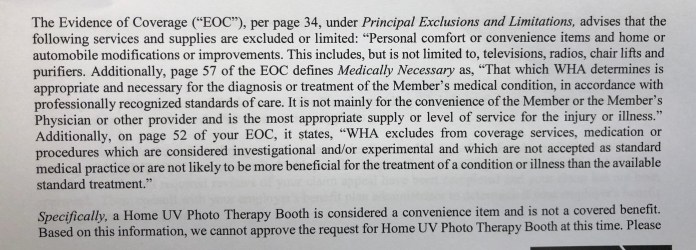
The argument now, in addition, is that a phototherapy unit is a convenience item, not unlike a television or radio. What? That’s really what they wrote.
IMG_8755

Excerpt from the letter:

“The following services and supplies are excluded or limited: ‘Personal comfort or convenience items and home or automobile modifications or improvements. This includes, but is not limited to, televisions, radios, chair lifts and purifiers.’ . . . Specifically, a Home UV Photo Therapy Booth is considered a convenience item and is not a coverered benefit.”

I understand that WHA does not want to pay for this unit. But calling it not medically necessary, and a convenience item flies in the face of current dermatologic medical practice. Or am I going crazy? I am going crazy.

I Give Up?

At this time I need to lick my wounds and discuss with my dermatolgist what to do next. At the National Psoriasis Foundation corporate roundtable in Chicago last summer someone mentioned to me that my dermatologist can request to talk to another dermatologist at the insurance. That might be the way to go as the physician who wrote the second letter is not a specialist.

I am also considering buying a scaled down unit directly from the manufacturer. Another option is to just get out in that beautiful California sunshine that should be arriving any day with the coming of spring. WHA can’t stop me from going to my backyard to get some naturaly UVB.

Whatever happens next I won’t give up, though I honestly don’t know how effective more appeals will be. The more I appeal, the more reasons they give to NOT cover the phototherapy booth. Still, at the end of the day, I am grateful for WHA covering my biologics and my family’s hospital stays. But the UVB unit would be nice too.

Standard
Advocacy, psoriasis

Joining NPF on Capitol Hill

Lori and I in Sacramento for California Advocacy Day with the National Psoriasis Foundation in 2017. The NPF produced this graphic for a tweet promoting the upcoming Capitol Hill day on March 20, 2018. 

Screen Shot 2018-03-13 at 3.16.42 PM.png

Last year I very much looked forward to attending the National Psoriasis Foundation’s Capitol Hill Day in the nation’s capital. Alas, due to inclement weather and subsequent flight cancellations, I didn’t make it. I wrote Not Going to DC After All, But . . . to share my sadness. While I did conference call into a couple of congressional meetings, I missed meeting psoriasis patient and research advocates, as well as congressional staffers, in person.

This year I’m hoping the storms hold off long enough for my flight to land at Ronald Reagan National Airport on Sunday evening. If they do I’ll not only check off another item off of my psoriasis bucket list, but also join in a cause I’ve become increasingly passionate about.

Growing in Psoriasis Advocacy

For years I envisioned myself as a volunteer coordinator for building psoriasis community locally. I joined the NPFs Los Angeles community division a decade ago and started the San Gabriel Psoriasis Support Group meeting at a local Kaiser facility. Although that group did not continue after I moved back to Northern California, I felt the monthly gathering made an impact.

In Northern California the NPF Community Division Manager gave me the vision of establishing a group in the Sacramento area. We hosted More Than Skin Deep and Team NPF Walk events over the past few years. However, during this time I felt the tug to focus more time on writing blogs and on local advocacy.

I attended the first advocacy day in Sacramento a few years ago where the NPF teamed up with the Arthritis Foundation and other groups to support state legislation. Some bills we lobbied for included striking down step therapy, promoting continuation of care, and developing standards for biosimilars.

Before one of the California Advocacy days the NPF called to ask me to represent the organization in support of a bill. I took off a morning from work to sit in on a health committee meeting. I waited for my moment to stand in line and express support for the bill. That day the NPF staffer told me I became a lobbyist.

Recently I joined the NPF’s Western Advocacy Action Network representing California. Next week I’m taking my very amateur lobbyist skills to Washington D.C. for the first time. I didn’t expect to become involved to this level in legislative advocacy, but I see the power of influencing government for the greater good of the patient community.

Travel and Psocial Ambassador Training

Getting to D.C. is a daunting proposition, however. Living on the West Coast has a few disadvantages. One of them is traveling to the East Coast for meetings. Since my first meetings with the NPF Psocial Ambassador group starts at noon on Monday morning, I need to travel on Sunday afternoon.

Psocial Ambassador logo.jpg

With speaking at 9 a.m. and teaching a class at 10:30 a.m. at church, the best flight out of Sacramento for me is in the early afternoon. I already know I will be exhausted with the packing, preparation for the lessons, speaking/teaching, and travel through Chicago’s O’Hare airport. I don’t arrive in D.C. until around 11:45 p.m.

Sunday is my big work day that takes everything out of me. Traveling and two days of meetings will be challenging, especially with the time change.

But it’s worth it. I can’t think of a better way to spend those couple days giving myself to a cause I deeply believe in. I’m also looking forward to meeting the other two dozen plus patient advocates who will attend.

I plan to update how things are going during and after the trip. Definitely looking forward to all those couple days have in store for the Foundation and me.


Standard
psoriasis, Psoriasis Treatments

28 Weeks with Tremfya: Still Working? (Injection #5)

March 5th finally arrived–injection day. The time came for the fifth dose of Tremfya (guselkumab) twenty-eight weeks after starting this treatment journey with it in August.

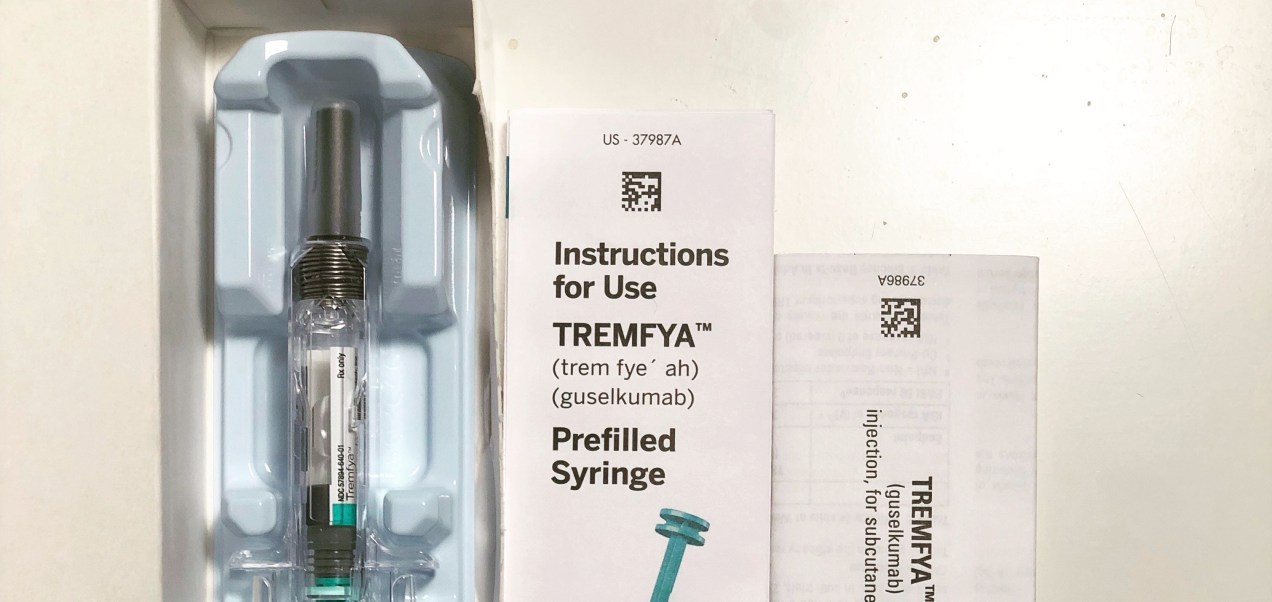
To prepare I carefully laid out the syringe, the instruction booklet, information sheet, a cotton ball, and alcohol wipe on my desk. As I waited for the medication to warm up for a few minutes my thoughts began to wander.

Would I take Tremfya if my insurance didn’t pay for the approximately ten thousand dollars per injection?

Is there any chance for even greater improvement as I go into the second half of a year taking it?

Will any long-term side effects eventually pop up if I take Tremfya over a long period?

As I grabbed the syringe I figured the answers are 1) no–it’s way too expensive, 2) probably not–I’ve probably seen what it can do already, and 3) I hope not–and that scares me to these three questions. I submitted to the fact that I can’t know everything I want to know about taking a new medication even after using it for over half a year.

Thankfully, the needle and medication went under my skin with no issues. Not even a tiny drop of blood emerged as the needle pulled out. Now it’s time to wait to see how effective this injection will be for weeks 28 to 36, and would it follow the pattern I’ve observed with the past couple injections.

The Pattern Continues

In 24 Weeks with Tremfya: A Pattern Emerges I discussed a pattern I observed with the eight week between injections. About two weeks before the next injection my psoriasis worsens. Then two weeks after the injection my psoriasis begins to improve again. I most enjoy the four weeks in between.

During the previous eight weeks I did have a nagging respiratory injection that seemed to worsen both my psoriasis and atopic dermatitis. While it’s possible the break out is due to the lingering effects of infection, I also see it as a potential confirmation of the pattern I described.

This picture I took earlier this week shows how my psoriasis broke out some on my lower back and upper arms. Continue reading

Standard
Living with Psoriasis, psoriasis, Psoriasis Treatments

An Almost Disastrous First Dermatology Visit

IMG_8511

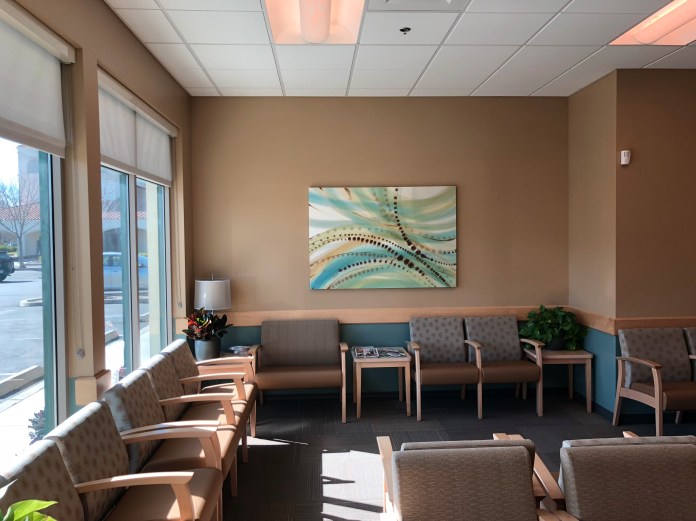
The empty lobby at the dermatology clinic at lunch time left me feeling quite anxious after I missed my 11:30 a.m. appointment, which I thought was at 1:30 p.m.

Wednesday morning started out quietly enough. I took the morning to rest as I had to work on my Monday day off. I looked forward to my first dermatology appointment at 1:30 p.m. I drove into town around 12:30 to give myself plenty of time. Then it dawned on me.

My dermatology appointment was at 11:30 a.m., not 1:30 p.m.

After double checking my calendar I decided to drive straight to the clinic. Even though the door was unlocked, I only found an “out to lunch” sign on the counter. A call to the scheduling center confirmed I missed my appointment. I’d waited over two months for this visit. Now I found myself one hour late to it.

The scheduler on the phone told me I could take the next available appointment with the dermatologist on May 8th, or with her colleague on May 2nd. She also gave me the option to stay in the clinic office until the staff returned from lunch. I opted for the latter.

As I waited all I could think about is what a disaster the first visit is turning out to be. Being late meant possibly not seeing the new dermatologist for weeks. One little mistake could mushroom into huge consequences for all my treatments.

As I waited all I could think about is what a disaster the first visit is turning out to be. Being late meant possibly not seeing the new dermatologist for weeks.

Awkward Beginnings

Finally, someone returned to the office. I sheepishly asked if she had started working yet, and shared how I felt embarrassed about missing my 11:30 appointment. The receptionist said it was okay, and took my information down. She then asked me to wait until the medical staff returned.

Dr. C’s medical assistant returned and started looking into my situation. He said they could work me into her schedule, but I needed to wait there for up to two hours. Ironically, I ended up getting a 1:45 p.m. appointment, only 15 minutes later than what I first thought. Around 2:00 p.m. the medical assistant called me into the exam room.

I felt anxious changing to a new medical group and system. Right off I felt awkward when I tried to sit on the exam table and asked for a gown.

“On the first visit the doctor likes you to keep your clothes on and sit in the chair,” the assistant informed me. I thought it sounded like rules for a first date, but went with it.

I felt anxious changing to a new medical group and system. Right off I felt awkward when I tried to sit on the exam table and asked for a gown.

Next, he told me the doctor is using an exam recording device that transmits to the Dominican Republic. It apparently helps with documentation so the doctor doesn’t need to worry about writing notes later. I didn’t want to make a fuss on my first visit and told him it would be fine.

Dr. C. walked in a few minutes later. She told me right away that she didn’t have that much time for the visit since I was being squeezed into her schedule.

Having no time to waste, I quickly dove into all my dermatology concerns assuming she could keep up. Continue reading

Standard