Family

How My Wife and I Support Each Other Through Chronic Illness

Howard Chang and his wife Lori found that being open about their chronic conditions brought them closer together.

Lori and I took this picture at the spot we got engaged in 1993 near Ghiradelli Square in San Francisco. It’s one of my favorite recent pictures of us together.

Happy Valentine’s Day to my dear wife, Lori! I can’t believe we met about 25 years ago at U.C. Davis as undergraduates. We bonded very quickly over the experiences of living with lifelong health condtions. Those health conditions persist to this day, with a few added to the picture as we become middle-aged. I would even say that psoriasis helped me find my wife

I wrote the following article for The Itch to Beat Psoriasis on Everyday Health a couple years ago on ways to support a loved one with chronic illness. I’m adding it here below as a reminder on Valentine’s Day of how far we have come through each other’s support and care.

 —————–

3 Ways to Support a Loved One With Chronic Illness

Finding the perfect gift for my wife, Lori, is always tricky. That’s because it’s not easy to express how much she means to me. She’s stood by as my main support through everything for more than 20 years, including living with a guy who has severe psoriasis.

As a minister, I officiate weddings and work closely with couples preparing for marriage. I always tell them that the center of the ceremony is the vows. The vow to love “in sickness and in health until death do us part” strikes me as especially solemn.

Many young couples sitting across from me do not truly comprehend the impact “in sickness” can have on their future lives. I know that Lori and I didn’t when we married in our early- and mid-twenties.

We hit it off immediately when we met as college students at the University of California, Davis. The two of us could speak for hours about anything and everything. We could especially relate on so many levels when talking about living with serious health conditions.

Lori was born with spina bifida, a neural tube defect that leaves the spinal cord and nerves open to damage. Doctors call hers a one-in-a-million case thanks to successful neurosurgery a few hours after birth. The condition did leave her with incontinence and neuromuscular weakness, but it could’ve left her incapacitated in a wheelchair.

The two of us could speak for hours about anything and everything. We could especially relate on so many levels when talking about living with serious health conditions.

Every year, I accompanied Lori to an all-morning spina bifida clinic. She stayed in an exam room while medical providers from nine different specialities, including neurology, urology, and nursing, checked her. After lunch, they discussed the patient’s condition and gave recommendations for follow-up.

During one visit, her worsening incontinence took center stage. The doctors and nurses couldn’t find a solution, suggesting possible surgery. I felt helpless as I witnessed her daily struggle trying to work and be a mom while emotionally frustrated by her condition. It took years to figure out how to best manage the incontinence, though no surgery was necessary.

My psoriasis also posed its challenges for Lori. She didn’t really understand or have much knowledge about the condition when we met, or during the early years of our marriage.

Lori admits she thought it was just a manageable itchy rash … nothing much to worry about. It would flare up at times, but there was oral medication, topical treatments, and dermatology appointments to get through it. Besides, Lori’s mom was facing terminal cancer, and the ensuing family drama after her death definitely took priority.

On the journey, Lori and I learned how to better support each other while managing our own anxieties, fears, and frustrations. Drawing from our experience, we brainstormed a few tips for people in support roles as they care for the most important people in their lives. Continue reading

Standard
psoriasis, Psoriasis Treatments

24 Weeks with Tremfya: A Pattern Emerges

Twenty-four weeks ago on Monday, August 21, 2017, I took my first injection of Tremfya (guselkumab) to treat my severe psoriasis. That day I witnessed a solar eclipse as I drove to the dermatology clinic in Sacramento. I recalled the day in grade school (February 26, 1979) when the last total solar eclipse occurred in the Northern Hemisphere. That’s around the time when the first psoriasis lesions emerged on my skin.

Over the course of those almost four decades between total solar eclipses I’ve battled severe psoriasis. Sadly, few treatments helped to effectively relieve the inflammation over those years.

I survived messy and smelly coal tar formulations, phototherapy burns, painful side effects of soriatane/etretinate, liver biopsies with methotrexate, rising blood pressure with cyclosporine, and five biologic mediations with injections. Not to mention the strange diets, supplements (I need write about the snake skin powder), alternative Chinese medications, and other unmentionables I tried to “cure” my psoriasis.

Over the course of those almost four decades between total solar eclipses I’ve battled severe psoriasis. Sadly, few treatments helped relieve the inflammation over those years.

Would Tremfya finally be the treatment to eclipse the nagging psoriasis all over my skin?

High Hopes and Expectations for Tremfya

Going into the clinic for my first injection I felt both excited and nervous. All those hopes and dreams of wanting to find “the one” treatment rested in that syringe full of medical innovation. That’s a lot of pressure and expectation on one treatment.

I knew before long that Tremfya would not be the cure I desired, even though it never promised to be one. By week 6 I began to redefine my expectations:

So, I’m lowering my expectations for Tremfya. I do hope this awesome new medication can beat the lowered expectations.  But if it can’t quite climb to the top of that mountain, I’ll take something less. I’ll take less than clear skin. I’ll accept if it needs something other than cyclosporine, such as phototherapy, or stronger topical treatments, to work more effectively at suppressing psoriasis.

Of course, I still hope it clears my skin in a couple months. But if it doesn’t by week seven or eight, I won’t fret about it not doing its job . . . at least not quite yet.

Going into week 21 I’m not fretting about whether or not Tremfya will work or not. Instead, I’m observing a pattern emerge on how it works with my psoriasis. Continue reading

Standard
Family, Nature

The Super Blue Blood Moon

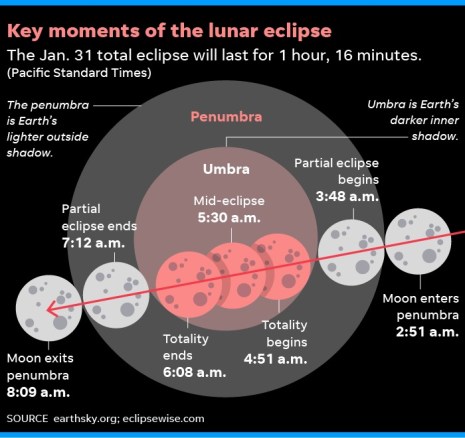
The awe-inspiring lunar eclipse this morning from the backyard of our house near Sacramento in Northern California.

I set the alarm for 4:30 a.m. this morning to catch the rare super blue blood moon. A super moon happens when the moon in particularly close to the earth. A blue moon is a second full moon of a calendar month, January. A reddish blood moon comes when the moon is in the earth’s shadow during the eclipse. It’s rare for all three to happen at the same time.

When I heard that the West Coast would provide some of the best views I set my mind to wake up to see it. Little did I know that my son stayed up to catch the whole -rogression from partial eclipse to totality. By 5:15 a.m. the entire family stood in the sub 40 degree cold to look up at the sky to see a sight not seen since 1866.

1517142071_eclipse.jpeg

My son used an iPhone camera in the eyepiece of our Celestron telescope to take the photos. We defintely need a better set-up for photos, but the pictures still looked amazing. Here’s a picture of the partial eclipse. Continue reading

Standard
psoriasis

My Surefire Skin Trigger

The last few weeks I’ve lived with one enduring fear: catching a cold or flu from all the sickness around me. The flu has hit my area hard, including my church and workplace, to the point I didn’t even want to leave my house.

I try to avoid getting ill mainly for one reason–it’s a surefire trigger for my skin conditions.

A Lifelong Skin Trigger

My very first major break-out of guttate psoriasis came on the heels of a strep throat infection I sustained as an eight year-old. My body became quickly covered with those drop-like red sores characteristic of guttate. I remember lying on the ground of the living room, overheated, crying as the fever and skin sores overran my body.

The last few weeks I’ve lived with one enduring fear: catching a cold or flu from all the sickness around me.

The infections came more often when I started immune suppression therapies such as cyclosporine and biologics. I know it’s difficult to say that a certain medication caused me to contract certain infections, but that’s an observation from my experience.

Bacterial infections such as strep throats, ear infections, and staph on the skin all flared my psoriasis and eczema. Viral infections, such as flus and colds, did the same.  About four years ago I contracted Influenza A. The respiratory viral panel confirmed I had an H3N2 virus. I can’t remember ever feeling so poorly with a viral infection. Tamiflu didn’t help much either. And boy did my skin break out with vengeance. It took weeks to calm that flare.

Whenever a fever hits with an infection I know my skin wil break out not too long after.

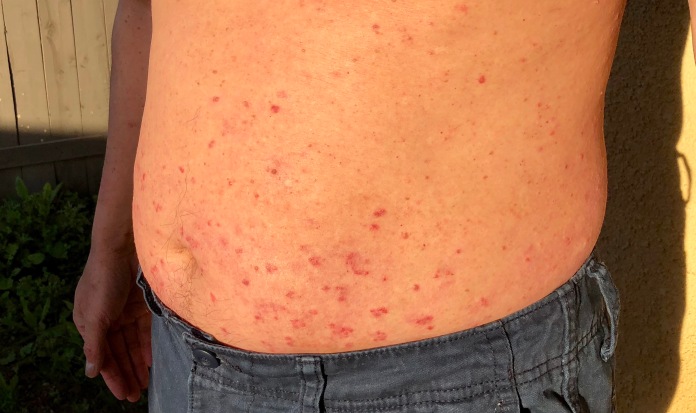
This time around seemed milder than others, though. The fever stayed low-grade for about twenty-four hours. Sure enough my skin broke out. I took a photo of my stomach to show how this characteristic guttate-like psoriasis looks when I get it.

IMG_8406.jpg

January 20, 2018. Psoriasis broken out on my stomach after a viral infection with a mild fever.

Sadly, I fear my skin will worsen yet as I took the photo just a day after the fever broke. Calming the flares from these infections can take a couple weeks or more depending on what other factors might be involved.

Living with Skin Triggers

Of course, the moral of the story is to avoid psoriasis and eczema triggers at all costs. But sometimes they can’t be avoided, especially during one of the worst cold and flu seasons we’ve had in many years. I washed my hands, tried not to touch my eyes or nose, and avoided touching certain surfaces such as doorknobs in public. Still I contracted a virus.

Of course, the moral of the story is to avoid psoriasis and eczema triggers at all costs. But sometimes they can’t be avoided.

Living with skin triggers is a fact of life, unfortunately.

I know, however, that this flare won’t last forever. Once the trigger is removed my skin will eventually start to improve. That fact does give me a measure of comfort. I do wish, though, I had that home phototherapy unit, or stronger natural sunlight, to help calm this flare. A wet-wrap with topical steroids could help also. I don’t want to do the wet wrap quite yet as it cools my body for a few hours. I’m still recovering from my viral infection.

I would love to hear from you! Do infections trigger your skin conditions? What do you do to lessen their impact?

Standard