Living with Psoriasis, psoriasis

My Last Dermatology Visit: As Good as It Gets?

I couldn’t believe what I read in a letter dated November 21 from Western Health Advantage (WHA), my health insurance provided. They approved my continuation of care request for one more visit in December.

I’d already said goodbye to Dr. M and his team at the November appointment. With excitement, I called the Dermatology department to book my last dermatology visit at UC Davis Health. “I’m sorry Mr. Chang,” she flatly said, “Dr. Maverakis does not have any open appointments for the rest of the year.”

Getting that Elusive Last Appointment

What? After waiting weeks to hear back from WHA I now faced denial at the dermatology office? “You can call back as many times as you want to check for cancelled appointments,” the receptionist told me. They don’t keep a waiting list, but would be fine if I called ad infinitum.

So, I called back a few days later. No appointments still. Another call revealed that the university holidays on the last two weeks of the month hurt my chances of landing that coveted appointment. Then I called WHA about extending the continuation of care. Let’s just say that 45-minute phone call made me want to call back UC Davis to get an appointment in December.

Finally, the receptionist took pity on me. He said he would write my name and number down and give me any cancellations that arose. Sure enough, within a few hours, I booked a 9:15 a.m. on Friday morning, December 15th. Why couldn’t he do that from the start? Anyhow, I felt grateful to have the appointment no matter how I got it.

With this health care system, I’m guessing this is as good as it gets.

Assessing my Skin Concerns

Dr. M understandably wants me to taper completely off of cyclosporine. Tremfya (guselkumabis the key treatment we looked to replace it. This visit happened to coincide with my 17th week on the new biologic.

Check out the new Treatments Tried section with a list of Tremfya blogs.

How would he assess my psoriasis and eczema after using it for four months?

Continue reading

Standard
wellness

Everyday Health’s State of Women’s Wellness 2017: Lori’s Story

The other day I asked my wife, “Are you satisfied with your overall sense of wellness?” I waited for her response to vote in a Twitter poll from Everyday Health. She paused for a moment to think about it. I realized soon enough that she could not easily gauge her sense of wellness in that quick moment.


EHwomensWellnessLogo

The editor I work with at Everyday Health for The Itch to Beat Psoriasis alerted me that their special report, “State of Women’s Wellness 2017,” would post on December 15th.  The report covers how “American women define and rate their wellness based on factors like stress, illness, relationships, sex, BMI, financial health, and money.”

Through the survey and discussions with experts, they sought answers to the questions, “What’s standing in the way of women’s wellness, health, and happiness? What would it take to enable them to feel empowered and inspired to live their best lives and achieve their highest level of wellness?”

How the women in my midst respond to these questions directly impact me as a son, husband, father, and minister. I live with a wife from Gen X, a Millennial daughter, and an iGen daughter. The report highlights generational differences that affect them all.

What would it take to enable them to feel empowered and inspired to live their best lives and achieve their highest level of wellness?

As a moderately dense, somewhat self-centered male, I needed to listen to these results. I typically make judgments or evaluate others equally without concern for gender differences. I not only wanted to listen to the women behind the survey, I desired to listen to the women in my life as well.

I quickly noticed the top three wellness challenges that women face: 1) 44% Stress about life, 2) 43% Lack of Sleep, and 3) 43% Finding Time for Fitness/Exercise.

I know my wife worries about others, especially me and my health. With three children still at home, two of them teens and one managing mental illness, she has plenty to keep her mind occupied. As the report states, “When respondents were asked if they were likely to put their own needs first, only 24 percent responded that they would.”

I did not want to presume, though, how my wife feels about her state of health and wellness. The report ends with a powerful statement: “we all have powerful stories to tell.”

What follows is my wife Lori’s health and wellness story told in her own words.


Greatest Health Fear: Breast Cancer

Before I share about a wellness challenge and how I overcame it, I want to address a health fear that I struggle with. In the Women’s Wellness 2017 Special Report, there were 5 top fears that women have. One of them is cancer. Starting in my childhood, I’ve lost quite a few family and friends to cancer–the most common for women being breast cancer.

In the Women’s Wellness 2017 Special Report, there were 5 top fears that women have. One of them is cancer.

The most directly impactful personal loss was my mother. She had a particularly aggressive case of breast cancer which metastisized quickly and took her four years after diagnosis. She also had chronic autoimmune disorders throughout her adult life so it was difficult to find a cancer treatment that wouldn’t seriously harm her. It was an agonizing situation that left me without my mother–and my young children without their grandmother–right after Thanksgiving.

It has now been sixteen Thanksgivings and times have changed.

Our awareness of breast cancer has increased. October is Breast Cancer Awareness Month. While I am deeply appreciative of the fundraising and 5Ks that women run for this very worthy cause, at times it can be overwhelming for me to face all the pink ribbons in October. It can serve as a painful reminder that I will have to get through the holidays without my mom. I miss her every year.

However, I want to be prepared in case I find myself facing a similar diagnosis. I recently booked a consultation with a genetic counselor to see if I could carry a genetic risk for breast cancer. After the consultation, I felt that I better understood having a genetic risk versus normal aging and changes in breast tissue.

It is alarming to know that three women in my family faced breast cancer (two of my great-aunts as well as my mom) and only one survived. However, I do not carry a genetic risk. I will keep up with regular breast exams and yearly mammograms trusting that should I face a diagnosis, it will be caught early.

Biggest Wellness Challenge: Rest and Sleep

One wellness challenge that I’ve focused on is getting enough rest and sleep. According to the report, 81% of the women in the survey said they struggle to get a good night’s sleep. When our kids were young–we had three children within six years–it seemed impossible to get a good night’s sleep. Night feedings, children waking up to use the bathroom, having nightmares, our son even was a sleepwalker for a period of time left me with four hours of broken sleep on a good night.

It was frustrating to be woken up from dreamland and when I finally got back to bed, I would toss and turn waiting for another child to wake up. By 5am, I was fed up with trying to get any more sleep. To compensate, I resorted to my old trick during my college days when I was pulling all nighters writing papers: drinking coffee.

It was frustrating to be woken up from dreamland and when I finally got back to bed, I would toss and turn waiting for another child to wake up

At first that seemed to work. But then I noticed that my brain was foggy. It felt difficult to make rather everyday, easy decisions (as in what to cook for dinner) and I would find myself zoning out in the produce aisle while my kids sitting in the grocery cart helped themselves to the apples on display. In my experience, sleep deprivation fed on itself. It became a mental struggle.

I lost faith that I could get a good night’s sleep so I would go to bed with a lot of anxiety about it and with a rather valid concern as to how I would function the next day. Then it just became a pattern. Night after night, time dragged on. I became deeply depressed and in retrospect, I believe sleep deprivation was a key contributing factor.

I Just Need to Breathe

In therapy, we focus a lot on breathing. At first I felt this was not a very bright idea. I mean we just breathe naturally–what’s the big deal? But when I focused in on how I was breathing I noticed that it was rather rapid and shallow. I was even holding my breath.

As I practiced taking slower, deeper breaths I noticed that my whole body would calm down–including my mind. It became more difficult to focus on my anxiety about sleep as I focused on the rhythmic inhale and exhale of my breath.  I would even feel drowsy as I spent 8-10 minutes in a group relaxation session.

As I practiced taking slower, deeper breaths I noticed that my whole body would calm down–including my mind.

If it worked in a group setting, maybe I had a shot at making this work at home. I extended my relaxation session to 20 minutes lying down in bed. I began to have regular success with falling asleep and as the kids grew older, I wasn’t awakened at night quite as much as in the past.

The amount of time I spend sleeping improves my mood, prepares me for the next day, and even helps control my weight. At this time of year, I require more sleep. It can feel limiting not to spend more time with family or engaging in daily activities I enjoy, but I know it’s a good discipline for me that gives me energy and motivation for other areas of my life. The hours that I spend awake are more meaningful and that feels so much better than sleepwalking through life.


Standard
psoriasis, Psoriasis Treatments

16 Weeks with Tremfya: The Verdict?

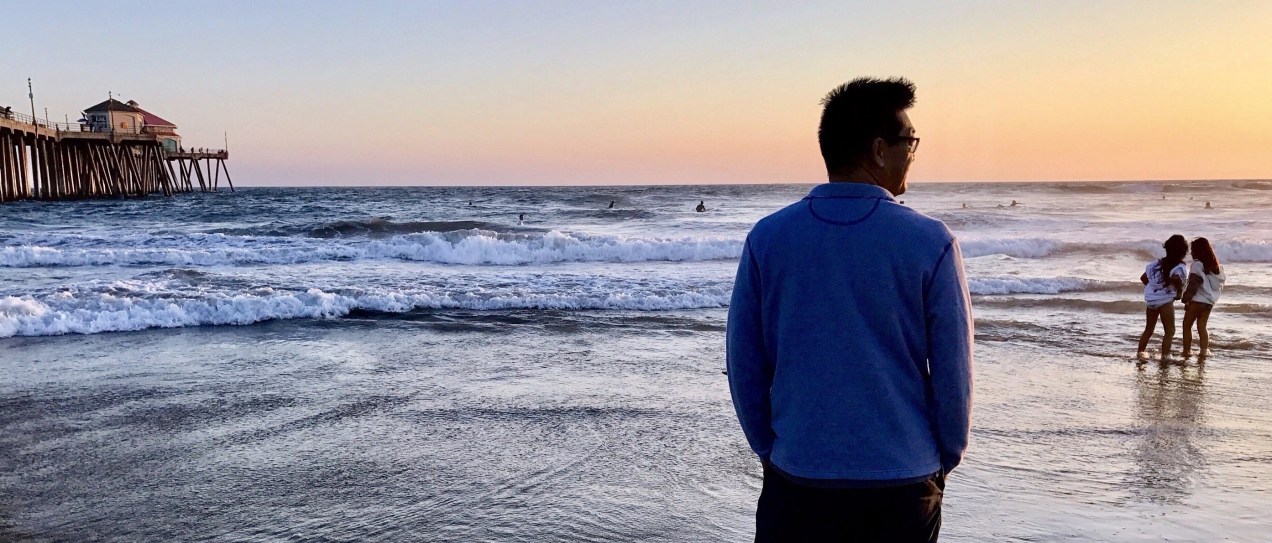
August 9, 2017 Huntington Beach, CA. I took this photo just before starting Tremfya in August in one of my favorite spots in the world.

I started my Tremfya (guselkumab) journey on Monday, August 21, 2017. Sixteen weeks is an important point to evaluate as clinical trials use this time to evaluate new medications. On December 11, after three injections (week 0, 4, 12), I reached that interim endpoint.

The clinical trial data shows that more than 90% of patients showed greater or equal to 75% improvement at 16 weeks. When I took that first injection, I hoped my body would assimilate Tremfya safely, while effectively shutting down the psoriasis inflammation all over my skin.

Below I evaluate my experience with Tremfya at 16 weeks. The following “verdicts” reflect a moment in time, and certainly are not final. As a disclaimer, my observations are from my personal experience only, and should not be construed as making any claims or predictions for anyone else who might try Tremfya.

How well is Tremfya working for me?

Quite well! After a roller coaster few months with tapering off of cyclosporine, atopic dermatitis (eczema) flares, and super stressful stretches of work, I’m amazed at the level of psoriasis clearance. I’m still on a small, small dose of cyclosporine, but no other biologic gave me this much skin clearance working together with even higher doses of cyclosporine.

After a roller coaster few months, I’m amazed at the level of psoriasis clearance with Tremfya.

I have yet to see my dermatologist this month (that is another story altogether trying to get an appointment with him), so I can’t say what percentage improvement I’ve experienced. But my guess is at least the 75% clearance, and probably more.

I promised photos in my last update. The following photos from July, October, and and December don’t lie.

Continue reading

Standard
psoriasis, Skln Care

5 Psoriasis and Eczema Winter Skin Care Tips

I published this blog for The Itch to Best Psoriasis on Everyday Health in January this year. This reprint has a few update modifications. Great reminders for myself as I ward off rashes and try to control the dryness that heating causes in the winter cold. 


Every winter, I sense the need to adjust how I care for my skin. Freezing cold night temperatures give way to cold, shortened days. My wife likes to turn up the heater, as do my workplace and the stores I frequent. I enjoy a hot shower too. But I know that my psoriasis and eczema don’t necessarily take well to dry, heated air and long, hot showers.

It could be the stress of the holidays, it might be because my medications have lost their effectiveness, or it could just be winter. Whatever the cause, I’m needing to take extra measures to make sure my skin is well managed and cared for.

When I visited my dermatologist, Dr. Emanual Maverakis of the University of California, Davis Health System last year, I wondered what winter skincare tips he and his resident Dr. Tatyana Petukhova might have for those of us living with psoriasis and eczema.

My years of experience have helped me develop ways to manage any inevitable winter flare-ups. Here are my five recommendations with a few of my doctors’ thoughts peppered in.

1. Be Sure to Moisturize and Humidify

Without a doubt, this tip to moisturize is the one my dermatologists recommended first. Dr. Maverakis noted that  using heaters in the winter dries out the skin, so more moisturizing is needed. That’s my experience as well.

I took a couple of climatology classes in college. One professor used the analogy of two different-sized buckets to explain relative humidity. If you have a small bucket, and it’s 80 percent full of water, then you would say it’s quite full.  But if you put that same amount of water in a big bucket, it might only be 20 percent full.

Cold air is like the small bucket, and hot air is like the large bucket. When cold air is heated up, as it often is indoors in the winter, the relative humidity drops. Unless water is added back into the air, such as with a humidifier, the dry air will dry out your skin.

Dry skin will easily become itchy and irritated. In the winter, it seems to dry out even faster than usual.

I’ve noticed my skin is like a hygrometer, a device that measures humidity. I can tell when my skin is dry and needs more moisturizer. Plus, dry skin will easily become itchy and irritated. In the winter, it seems to dry out even faster than usual.

When moisturizing, I start with a layer of a lotion with ceramides (mainly for eczema) to add moisture, then lock in the moisture with a thicker, petroleum-based cream. If I am moisturizing after a bath or shower, I moisturize within a couple of minutes of getting out to trap the moisture in my skin. It took me some time experimenting with different moisturizers, and talking with my doctors, before I settled on a regimen that works for me.

Finding the Right Moisturizer for Psoriasis & Eczema

Having a humidifier in the living room, bedroom, and the office helps too — especially during those cold and dry times. Dr. Petukhova also recommended using humidifiers, noting the need to “clean them regularly” and use a humidity level “that feels comfortable.”

2. Avoid Long Hot Baths or Showers

Simply put, hot water dries out your skin, and that’s generally not good for psoriasis or eczema. My dermatologists noted this tip as second important after moisturizing. But I confess I like to bathe in hot water in the winter. When it’s cold outside, or even cool, doesn’t everyone enjoy a hot shower or bath? After seeing Dr. Maverakis, I turned back the temperature of my shower and cut down the time.

I also will take 10- to 15-minute soothing baths. I sprinkle an over-the-counter oatmeal bath packet into the water as the bath is being drawn, then I add some moisturizing oil. When I get out of the tub, I put on extra layers of moisturizer. This system seems to be working well so far, but it’s hard to give up the hot water.

Continue reading

Standard