Psoriasis Treatments, Travel

42 Weeks with Tremfya: Coping with a Skin Flare

Beautiful flowers in Sitka, Alaska, taken during a stop on our summer Alaska cruise vacation with family.

A couple weeks ago marked the 42nd week on Tremfya (guselkumab) and the 7th injection. I started in mid-August last year with about ten months elapsed since that first injection on the day of solar eclipse in August.

At this point in my treatment cycle I hoped to have more stability with my skin. But skin flares do happen even while taking the best medications.

What a Bad Skin Flare

Somehow I think that if I’m taking a super expensive biologic for psoriasis that I’m entitled to clear skin. Expectations often wreak havoc on my mood when I think this way. As an optimist and idealist it’s quite easy to bring those unrealistic expectations to the new medications I take.

When my skin flared like a wind swept wildfire a month ago I felt overwhelmed. Between the darker red spreading psoriasis spots and the generalized bumpy rash all over my body I could only feel normal skin in a few places. My mood darkened as I went into coping mode.

When my skin flared like a wind swept wildfire a month ago I felt overwhelmed.

A few factors appeared to contribute to the flare: increasing phototherapy dosage too quickly; Tremfya losing effectiveness at the end of the 8 week cycle; completely stopping cyclosporine; stress at work with a demanding spring; and a busy schedule with end of school year activities for the kids.


Follow my Tremfya journey!

Tremfya (Guselkumab) Week One  

3 Weeks with Tremfya: The Waiting Game

8 Weeks with Tremfya: It’s Working!

12 Weeks with Tremfya: The Third Injection

16 Weeks with Tremfya: The Verdict?

20 Weeks with Tremfya: Read the Instructions! (4th Injection)

24 Weeks with Tremfya: A Pattern Emerges

28 Weeks with Tremfya: Still Working? (Injection #5)

38 Weeks with Tremfya: The Q&A Edition


Employing Poor Coping Strategies

I’m not proud to report that during the flare I didn’t cope well at all. I did continue my skin care routines including taking a break from phototherapy and using steroids with wet wraps a couple times. But my expanding gut tells me that I ate way too much junk food. All those pastries, ice cream, donuts, extra shots of espresso, greasy burgers, and chips of all sorts no doubt made my skin even worse.

I also tend to stay up later when my skin flares. In an ineffective attempt at avoiding caring for my skin I delay my shower and night time skin routines. Instead I play games on my cell phone, (binge) watch Netflix shows, work on emails, or read online sports news. Eventually I get going on what I need to do, but much later than I’d like. The next day I’m naturally tired and wanting naps in the afternoon.

I really could use more margin in my life for when difficulties like skin flares inevitably come. It’s not that I don’t know better ways to cope when my health tanks. But if I’m already tired and stressed I don’t have the will nor the energy to counter those cravings to eat junk food and stay up late.

I really could use more margin in my life for when difficulties like skin flares inevitably come.

Thankfully, vacation came at a great time. A week on an Alaska cruise settled my mind, gave me much needed time away from work, and allowed the new Tremfya injection to start working.

IMG_9816.jpg

Waterfall next to Mendenhall Glacier in Juneau, Alaska

Treatment: A Work in Progress

I hear stories of how long it takes to finally find a treatment plan that effectively manages psoriasis while minimizes risk. Some people go through multiple treatments, including combinations of various medications such as topical, phototherapy, systemic pills, and injectable biologics.

I feel like I’ve been trying to find that elusive treatment plan for the past twelve years. When the systemic Soriatane with phototherapy stopped working for me in the mid-2000s my skin would not stop peeling and scaling. Pure misery. I tried new biologics, went back to methotrexate, and even tried coal tar. Nothing worked.

Cyclosporine turned out to be the most effective medication for my psoriasis and eczema. However, it is only FDA approved for psoriasis for one year because of it’s toxicity to the kidney and other side effects. I used cyclosporine off and on for the next decade while trying each new biologic, although the breaks would only last a couple months before I needed to start up again.

Psoriasis treatment just feels like a work in progress, especially when that bad flare comes along unexpectedly.

Now I’ve finally stopped cyclosporine while taking Tremfya and experimenting with phototherapy. Psoriasis treatment just feels like a work in progress, especially when that bad flare comes along unexpectedly.

Time to end this entry with a photo of a cool glacier in Alaska to remember those calmer days. Too bad I can’t just go back here whenever my skin flares!

Margerite Glacier

Glacier Bay National Park, Alaska

Standard
psoriasis, Psoriasis Treatments

Denied! Insurance rejects appeals for Home Phototherapy

I am getting tired and frustrated with my health insurance provider. Really.

On December 15, 2017 my dermatologist, Dr. Maverakis, prescribed a home narrowband Uphototherapy unit. This unit, costing about five-thousand dollars, would treat both my psoriasis and atopic dermatitis (eczema).

With changing medical providers on January 1, I waited until I could see my new dermatologist. After almost missing the appointment, she agreed to submit the application that Dr. Maverakis started a couple months prior.

Surprise! not too long after I received the response from Western Health Advantage, my church’s health insurance provider.

First Insurance Denial

IMG_8668

Here’s an excerpt from the letter:

“The requested service, Home UV Photo therapy booth is being denied by Western Health Advantage (WHA) because it is currently considered Experimental/Investigational for a diagnosis of Psoriasis/Atopic Neurodermatitis. . . . and not a covered benefit under your health insurance plan.”

I couldn’t believe that WHA called home phototherapy “Experimental/Investigational” when I had used it effectively for many years earlier in life. I felt pessimistic about winning an appeal given how their reasoning, and how onerous the appeal process feels.

I Appeal!

Nonetheless, Dr. Carroll and I both sent appeals to WHA. Below is a copy of my letter, which I certainly thought would change the minds of those making those hard decisions at the insurance company:

Dear WHA,

I am writing with regard to a denial letter I received dated February 23, 2018 for a Home UV Photo Therapy unit. I would like to appeal the denial of my dermatologist’s request for this unit to treat my psoriasis and atopic dermatitis.

With the careful supervision of my dermatologists, I have successfully and effectively used phototherapy at home for my skin conditions for many years. Starting in 1981 my father and I built a box with a design and prescription from UCSF Dermatology. I used that UVB unit design off and on for over 25 years until I moved back to California in 2006.  Thereafter I began using cyclosporine, which helped greatly. Now I need to stop using cyclosporine.

I have also utilized phototherapy at the clinic at various times over the past forty years, but do not feel at this time I can go to Sacramento from the Davis/Woodland area three times a week due to my work schedule demands and family needs. I thought a home unit would be perfect to augment my current psoriasis treatment.

Also, I feel it would help my atopic dermatitis. Since tapering down on cyclosporine treatment due to high blood pressure concerns, my atopic dermatitis has become more unpredictable and severe. I mainly use topical steroids for atopic dermatitis, which is not a good long-term solution given the widespread area it affects my skin. My dermatologist and I also considered using Dupixent, the new biologic for atopic dermatitis, but wanted to try the home phototherapy unit first.

While I understand the medical literature is conflicting as to the safety and efficacy of home phototherapy, each patient is an individual and unique case. In my case I need a combination of therapies to keep my immune mediated skin conditions under control.

I do hope that WHA reconsiders approving the phototherapy unit for me given my medical history of using a myriad of treatments over40 years, including home phototherapy.

Sincerely,

Howard H Chang

Second Insurance Denial

The appeals did not work. On March 21st my wife and I heard a package delivered to the front door. Insurance sure does spend a lot of money using FedEx to send denial letters overnight!

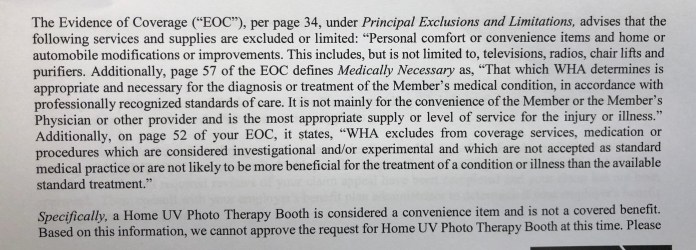
The argument now, in addition, is that a phototherapy unit is a convenience item, not unlike a television or radio. What? That’s really what they wrote.

IMG_8755

Excerpt from the letter:

“The following services and supplies are excluded or limited: ‘Personal comfort or convenience items and home or automobile modifications or improvements. This includes, but is not limited to, televisions, radios, chair lifts and purifiers.’ . . . Specifically, a Home UV Photo Therapy Booth is considered a convenience item and is not a coverered benefit.”

I understand that WHA does not want to pay for this unit. But calling it not medically necessary, and a convenience item flies in the face of current dermatologic medical practice. Or am I going crazy? I am going crazy.

I Give Up?

At this time I need to lick my wounds and discuss with my dermatolgist what to do next. At the National Psoriasis Foundation corporate roundtable in Chicago last summer someone mentioned to me that my dermatologist can request to talk to another dermatologist at the insurance. That might be the way to go as the physician who wrote the second letter is not a specialist.

I am also considering buying a scaled down unit directly from the manufacturer. Another option is to just get out in that beautiful California sunshine that should be arriving any day with the coming of spring. WHA can’t stop me from going to my backyard to get some naturaly UVB.

Whatever happens next I won’t give up, though I honestly don’t know how effective more appeals will be. The more I appeal, the more reasons they give to NOT cover the phototherapy booth. Still, at the end of the day, I am grateful for WHA covering my biologics and my family’s hospital stays. But the UVB unit would be nice too.

Standard
Family

How My Wife and I Support Each Other Through Chronic Illness

Howard Chang and his wife Lori found that being open about their chronic conditions brought them closer together.

Lori and I took this picture at the spot we got engaged in 1993 near Ghiradelli Square in San Francisco. It’s one of my favorite recent pictures of us together.

Happy Valentine’s Day to my dear wife, Lori! I can’t believe we met about 25 years ago at U.C. Davis as undergraduates. We bonded very quickly over the experiences of living with lifelong health condtions. Those health conditions persist to this day, with a few added to the picture as we become middle-aged. I would even say that psoriasis helped me find my wife

I wrote the following article for The Itch to Beat Psoriasis on Everyday Health a couple years ago on ways to support a loved one with chronic illness. I’m adding it here below as a reminder on Valentine’s Day of how far we have come through each other’s support and care.

 —————–

3 Ways to Support a Loved One With Chronic Illness

Finding the perfect gift for my wife, Lori, is always tricky. That’s because it’s not easy to express how much she means to me. She’s stood by as my main support through everything for more than 20 years, including living with a guy who has severe psoriasis.

As a minister, I officiate weddings and work closely with couples preparing for marriage. I always tell them that the center of the ceremony is the vows. The vow to love “in sickness and in health until death do us part” strikes me as especially solemn.

Many young couples sitting across from me do not truly comprehend the impact “in sickness” can have on their future lives. I know that Lori and I didn’t when we married in our early- and mid-twenties.

We hit it off immediately when we met as college students at the University of California, Davis. The two of us could speak for hours about anything and everything. We could especially relate on so many levels when talking about living with serious health conditions.

Lori was born with spina bifida, a neural tube defect that leaves the spinal cord and nerves open to damage. Doctors call hers a one-in-a-million case thanks to successful neurosurgery a few hours after birth. The condition did leave her with incontinence and neuromuscular weakness, but it could’ve left her incapacitated in a wheelchair.

The two of us could speak for hours about anything and everything. We could especially relate on so many levels when talking about living with serious health conditions.

Every year, I accompanied Lori to an all-morning spina bifida clinic. She stayed in an exam room while medical providers from nine different specialities, including neurology, urology, and nursing, checked her. After lunch, they discussed the patient’s condition and gave recommendations for follow-up.

During one visit, her worsening incontinence took center stage. The doctors and nurses couldn’t find a solution, suggesting possible surgery. I felt helpless as I witnessed her daily struggle trying to work and be a mom while emotionally frustrated by her condition. It took years to figure out how to best manage the incontinence, though no surgery was necessary.

My psoriasis also posed its challenges for Lori. She didn’t really understand or have much knowledge about the condition when we met, or during the early years of our marriage.

Lori admits she thought it was just a manageable itchy rash … nothing much to worry about. It would flare up at times, but there was oral medication, topical treatments, and dermatology appointments to get through it. Besides, Lori’s mom was facing terminal cancer, and the ensuing family drama after her death definitely took priority.

On the journey, Lori and I learned how to better support each other while managing our own anxieties, fears, and frustrations. Drawing from our experience, we brainstormed a few tips for people in support roles as they care for the most important people in their lives. Continue reading

Standard
psoriasis, Psoriasis Treatments

16 Weeks with Tremfya: The Verdict?

August 9, 2017 Huntington Beach, CA. I took this photo just before starting Tremfya in August in one of my favorite spots in the world.

I started my Tremfya (guselkumab) journey on Monday, August 21, 2017. Sixteen weeks is an important point to evaluate as clinical trials use this time to evaluate new medications. On December 11, after three injections (week 0, 4, 12), I reached that interim endpoint.

The clinical trial data shows that more than 90% of patients showed greater or equal to 75% improvement at 16 weeks. When I took that first injection, I hoped my body would assimilate Tremfya safely, while effectively shutting down the psoriasis inflammation all over my skin.

Below I evaluate my experience with Tremfya at 16 weeks. The following “verdicts” reflect a moment in time, and certainly are not final. As a disclaimer, my observations are from my personal experience only, and should not be construed as making any claims or predictions for anyone else who might try Tremfya.

How well is Tremfya working for me?

Quite well! After a roller coaster few months with tapering off of cyclosporine, atopic dermatitis (eczema) flares, and super stressful stretches of work, I’m amazed at the level of psoriasis clearance. I’m still on a small, small dose of cyclosporine, but no other biologic gave me this much skin clearance working together with even higher doses of cyclosporine.

After a roller coaster few months, I’m amazed at the level of psoriasis clearance with Tremfya.

I have yet to see my dermatologist this month (that is another story altogether trying to get an appointment with him), so I can’t say what percentage improvement I’ve experienced. But my guess is at least the 75% clearance, and probably more.

I promised photos in my last update. The following photos from July, October, and and December don’t lie.

Continue reading

Standard