psoriasis, Psoriasis Treatments

Finding the Right Moisturizer for Psoriasis & Eczema

[This article originally posted on The Itch to Beat Psoriasis, Everyday Health on July 7, 2017.  In the article I did not mention any products. Here I’ll say that the moisturizers I use currently are CereVe Moisturizing Cream, Cetaphil Moisturizing Cream, Eucerin Creme, and Aquaphor Ointment. My use is not a product endorsement, but could be ideas to get you started if you’re looking to try something new.] 

I didn’t grasp the importance of using moisturizers on my dry skin until my mid-thirties. Back then I broke all the rules. I used my lotions and creams intermittently, not routinely. I took two showers a day, which I later learned was stripping my skin of natural oils. At every clinic appointment, my dermatologist noted the parched, dry desert that was my skin. I ignored his pleas for me to moisturize my skin.

Then I endured the worst stretch of skin health in my life. Psoriasis covered more than 95 percent of my body, and I was overwhelmed by feelings of depression. My dermatologist referred me to the Psoriasis Treatment Center at the University of California in San Francisco.

One nurse told me that their patients moisturize every two hours. I just nodded my head in agreement, not mentioning how my lotions and creams sit idle most days. Even though I didn’t end up receiving treatment there, I learned a valuable lesson that stays with me to this day: Moisturize your skin regularly.

Why Moisturize?

Since I have both psoriasis and eczema, I have double the reason to moisturize my skin.

On its website, the National Psoriasis Foundation (NPF) states that “keeping the skin lubricated on a daily basis is an important part of psoriasis care because it reduces redness and itching and helps the skin heal.”

Vivian Shi, MD, assistant professor of dermatology and director of the Eczema and Skin Barrier Clinic at The University of Arizona in Tuscon, has written that moisturizers work by “directly hydrating the skin,” and “bolstering the skin barrier to prevent the skin from losing water.”

I first met Dr. Shi when she was a resident at the University of California in Davis dermatology clinic in Sacramento, and I came to know her work better when I volunteered for an eczema study she conducted. I enjoyed catching up with her over the phone recently about skin moisturizers. On the call, she reinforced the importance of finding an effective moisturizer, as well as adhering to a skin moisturizing plan.

Narrowing Your Search

I asked Shi what was the right moisturizer to use on my skin. “Find the one that you will use,” she says. “At the end of the day, you have to pick one that you will use.” She cautioned me to avoid parabens, dyes, fragrances, and other allergens since I have sensitive skin.

Skin-care products dominate entire stores shelves. so how do you narrow your search for a moisturizer? One way is to look for stamps of approval from organizations such as the National Eczema Association (NEA). I also read articles like the NPF’s blog post, 10 Must-Have Lotions for Under $10, to get ideas. Physicians will often provide free samples to try at home, and I also enjoy sharing moisturizer and treatment ideas with friends and acquaintances.

Part of searching for a moisturizer is learning more about them. For example, Shi’s article taught me the difference between “fragrance-free” (no substances are used to impart an odor) and “unscented” (the product may have a fragrance that’s masked by another substance). She recommends fragrance-free products.

What about the difference between ointment, cream, and lotion? Ointments are the thickest moisturizers and do a great job of preventing water loss. Creams are less greasy than ointments, as they mix greases with a liquid, such as water. But according to the NEA, creams may “contain stabilizers and preservatives to prevent separation of their main ingredients, and these additives can cause skin irritation or even allergic reactions for some people.” Shi notes that lotions contain more liquid or water than grease. Since this liquid evaporates quickly, lotions generally don’t moisturize dry skin as well as ointments and creams.

I’ve used many ointments and creams over the years. Personally, I don’t mind a moisturizer that’s greasier, but I don’t like the feel of something like pure petroleum jelly. I tolerate thicker creams best. Cost and availability are also considerations. By weighing my needs and preferences, I’ve settled on products that I will use routinely.

Developing a Routine

Finding the right moisturizer is only half the battle. As Shi says, “the moisturizer is only good when applied on the skin.” I can certainly relate when she says that about 50 percent of people forget their doctor’s moisturizing directions as soon as they leave the office.

Over the last decade, I’ve refined a routine that works for my skin and lifestyle — a process that begins with a discussion with my doctor about my skin needs. I set aside time to moisturize at least twice a day. After I shower at night, I apply moisturizing cream within minutes of patting my skin dry. Then I apply topical prescription medication on affected skin lesions. When the weather is dry, I apply another layer of moisturizer after the topical medication.

I have the same routine in the morning, but without the shower. And keeping moisturizers in my backpack and at the office gives me the opportunity to moisturize outside of my two regular times if I feel the need.

Your routine will no doubt vary from mine. Some people, for example, set alarms on their phones to remind them to moisturize. Whatever you decide, stick to a routine that works. If you need to, modify your routine so that the moisturizers you’ve carefully chosen and paid for don’t sit idly on the shelf.

Standard
psoriasis

My Two Worlds

The National Psoriasis Foundation’s Volunteer Conference is held in Chicago this year. The first time I visited Chicago I went to Millenium Park where I took pictures of the Cloud Gate sculpture, or popularly known as ‘The Bean.’

This weekend I’m in Chicago for the National Psoriasis Foundation’s Volunteer Conference. On my last day before heading out to the conference, my colleague at church told me to have a nice vacation. I began to tell him that it would not be much of a vacation, but I stopped myself not wanting to explain my conference schedule to him.

I largely live in two worlds: one as a pastor/minister at a local church in a college town, and the other as a patient advocate/blogger primarily with psoriasis advocacy. The two worlds do not overlap much, but they do inform each other.

My Church World

As a minister for almost twenty years I primarily oversee a congregation of over one hundred in an ethnically Chinese church. My group consists mostly of second generation Asian Americans, though they run the spectrum from more culturally Chinese to more culturally westernized. Some, like my wife, are not Chinese but adapt well to the Asian setting.

dad translate preach

On Good Friday I spoke to 250 gathered in our Davis, California church. The Mandarin Chinese translator, Shirley, works with me often when I speak in a bilingual setting.

The three pastors of the church, together with four non-pastor leaders (called elders) oversee the direction and care of the church. My training includes a Master of Divinity and a Doctor of Ministry, which I earned last year. I am also an ordained pastor and elder of the church. So people could call me “Rev. Dr. Pastor Elder,” although most call me “Pastor Howard.”

In this church world, I advise and work with volunteers in all church functions. I do quite a bit of counseling, mentoring, speaking, hosting/visiting, teaching, and team building. I officiate weddings, funerals, baptisms, child dedications, and communion services.  It’s a full-time position and then some.

The church sits a block north of the University of California, Davis campus. My wife and I met at UC Davis as undergraduates, so it’s a homecoming of sorts for us when we moved back from Los Angeles in 2014. I enjoy the relative quiet of the small suburban, agriculturally based area of California’s Central Valley. With the university nearby we spend a lot of time with students and faculty/staff.

My Patient Advocacy World

My world as a psoriasis patient advocate started early and developed late. I learned to advocate for myself as a child, teen, and student with psoriasis. My parents, immigrants who worked day and night to provide for the family, left much for me to manage myself. As early as first grade I rode my bike to school and back.

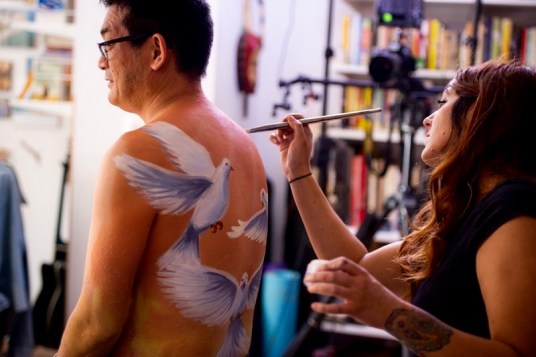
dad's body paint

Novartis sponsored Natalie Fletcher to body paint three patient advocates to raise psoriasis awareness. She painted three doves on my back to represent peace that comes from faith.

Around that time, I received a psoriasis diagnosis. I couldn’t ride my bike to phototherapy or doctor appointments, but I did call the pharmacy for medication refills and applied medications myself. If I needed anything I learned to speak up, make a call, or get it myself.

Self-advocacy led me to speak up about my psoriasis, despite the seemingly constant bullying, teasing, and misunderstanding associated with a skin disease. It helped me to tell my story. I found more supporters than detractors, which continued to encourage me on the path of sharing openly and often about psoriasis.

The next step to begin blogging about psoriasis made sense in my mid-thirties. I answered the call to blog for an online health website called HealthTalk. Their psoriasis content included a couple patient blogs, webcasts, and other articles. I appreciated the site enough to ask if I could write for them.

The editor wrote back to tell me she did not want me to proselytize or write content too religiously focused or sourced. She liked my writing samples enough to take a chance on me. I learned quickly, though, that my two worlds would need to stay separate for a while yet. That blog on HealthTalk turned into The Itch to Beat Psoriasis on Everyday Health. I began to coordinate some of my work with the National Psoriasis Foundation at that time too.

HealtheVoices, the first of its kind conference for online health advocates, led me into a new phase of advocacy. I met other health advocates for the first time, including several psoriasis patient advocates. With psoriasis research and new medications coming online, the advocacy space opened to join blogger groups, and partner with health and pharmaceutical companies. [See Links to Blogs/Articles for more of my advocacy work and writing.]

Two Worlds Collide

For years, I didn’t mention my work as a minister, or use my Reverend title, in my psoriasis bios or writing. I wanted to be known as a patient advocate who lives with a severe chronic autoimmune disease first. But more recently I found other advocates sharing about their faith from time to time. When I asked Everyday Health about updating my bio, they welcomed the changes.

When I do head out for conferences I invariably end up talking about my faith or work. Almost every trip someone says, “You are a pastor, right? Can I ask you a question?” I’m ready to serve as a pastoral counselor at any time, even on a psoriasis related trip. Sometimes people ask me about my work as a minister.

At church, I often share about my health journey as an illustration of living authentically by faith in a broken world. I personally pray for strength to persevere, and even seek healing and relief from my conditions. Those at church know when I change medications, take trips for conferences, or organize local psoriasis events for the National Psoriasis Foundation.

They welcome my advocacy work as an extension of my work at the church. I appreciate their support and concern for my health. I’m also careful to use my vacation leave for psoriasis related trips so the church does not bear any undue burden for my advocacy.

In both these worlds I feel empowered to help and serve others, albeit in different arenas. That’s why I chose Inspire, Empower, and Advocate as my three themes for PsoHoward.com. I learned that my two worlds actual are both a significant part of me as an expression of who I am and what I sense my calling to be in this world.

2017 NPF National Volunteer Conference

As I write this I’m on the plane heading to Chicago O’Hare’s airport. Lines of thunderstorms hinder our descent from the west, so the pilot explained our path with take us farther north fist. I’m eager to land, get my ride to the downtown hotel, and settle into my room.

The next two days I’ll sit on a corporate roundtable panel, attend a Psocial Ambassador training session, lead a session for teens with psoriasis, table as a PsoSTRONG Ambassador (for LEO Pharma), and attend a reception and volunteer celebration.

This weekend is about psoriasis, but I’m looking forward to how my other world as a minister might come out in conversations and interactions too.

Standard
psoriasis, Psoriasis Treatments

9 Weeks Done with Otezla. Keep Going?

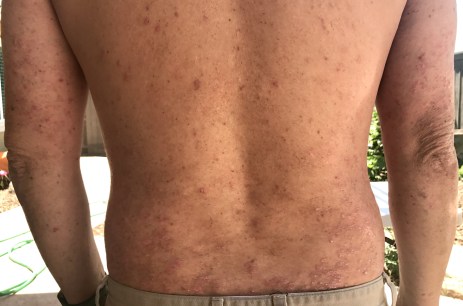
Note: below includes a picture of the current condition of my psoriasis on my back and arms. 

I’m entering the time when I expect to see more results from Otezla at two months. I started this new-to-me medication on May 15th for my psoriasis, and hopefully eczema. Unfortunately, instead of improving, I feel more and more inflammation on my skin than I have in a long time.

I had a great exchange with my dermatologist about Otezla. His response when I mentioned Otezla in the conversation?

🙄

I’ve known all along it’s not his favorite medication. Still, I’m hoping that it kicks in soon so I don’t have to switch medications again.

FullSizeRender

My lower back and upper arms are particularly broken out as I taper off from cyclosporine and enter my 3rd month on Otezla.

Tapering Cyclosporine

I’m not sure how much to temper my expectations since I also started tapering from Neoral (cyclosporine).

Neoral is a strong immunosuppressor. So, I’m not surprised it works so well for both conditions. I wouldn’t say I’m addicted to it, although I do like how much it keeps both psoriasis and eczema under control with relatively few noticable side effects. It’s hard to stop taking it for that reason.

This drug scares a lot of people, rightly so, as it comes with a long list of advserse effects, including kidney damage and hypertension. My body, though. tolerates it well. I’ve taken cyclosporine off and on for some years. The dermatologists allow me to go back on it after breaks partly because my labs come back mostly normal each time and it works for me. I’m sad to see it go.

Red Light, Green Light?

Stopping Otezla is also a difficult decision, but for another reason. What if it’s just days or a couple weeks away from reducing all this inflammation? I suffered the side effects for weeks and only recently do I feel they are not so severe. What if I persevered through all that insomnia, diarrhea, headache, and lost productivity for nothing?

If I don’t start something else soon, though, I could be covered in redness in a matter of weeks. If I do start another new medication, such as guselkumab that was FDA approved days ago, will that one work? How long might it take?

I’m not sure if I should give Otezla the red light or green light–even if only for a few more weeks.

It’s time to message my dermatologist again to see what he thinks I should do next if my condition doesn’t improve soon–although I already know what he thinks of Otezla. 🙄


Standard
psoriasis

Traveling with Psoriasis

[The view from The Getty Center in Los Angeles, June 2017]

I originally wrote this article for The Itch to Beat Psoriasis on Everyday Health. The editor needed to cut it down by almost half. My enthusiasm for travel apparently could not be contained in under 1000 words. So, I have the full, original article here.

————————————-

Last summer my family and I took a weeklong vacation to South Dakota to see the Badlands and Mount Rushmore. Besides waking the family up for the early morning flight, everything went according to plan. We went to lunch in downtown Rapid City, SD to pass the time before checking into the hotel. Then it dawned on me—I forgot my injectable biologic to treat my psoriasis in my backpack in the trunk of the rental car.

I immediately panicked, knowing that it would keep in room temperatures for a couple weeks, but not in a heated car in summer. We ran back to the car, and pulled out my backpack in a desperate attempt to save my medication. Sadly, it was too late—it felt as hot as the air in the car. After a quick call to the medication’s manufacturer I learned I couldn’t use it any longer.

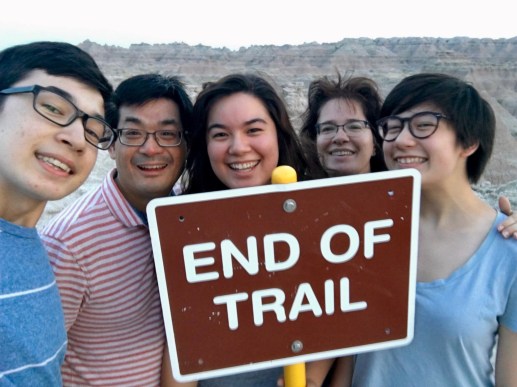
badlands sign fam

Last summer’s trip to South Dakota at the Badlands National Park. Unfortunately, I fried my biologic on the first day of this trip, but my skin mostly stayed under control.

In the end that incident didn’t ruin my trip or affect my skin adversely. I took it as a learning experience to not give up on travel, but to continue to refine how I travel. Even after making mistakes like at last summer’s vacation, I still look forward to traveling. Psoriasis need not take those opportunities away from me to see the world.

I do recognize, however, that traveling with a chronic condition like psoriasis takes special preparation and planning. The key principle I apply when traveling is to think about what I do at home for my psoriasis. Then, I take as much of what I do in my daily routine with me on the trip. What works at home often works on the road with some modification.

Scouring online I found some great articles on the topic of traveling with psoriasis in general, including 7 Tips for Traveling with Psoriasis here on Everyday Health. I keep those in mind as I share the process of what I do when traveling.

Preparing for an Upcoming Trip

A successful trip begins with preparation and packing. My before-the-trip routine begin with arranged travel plans so I know where I will be and when, including how I will get there. Once I know the destination and arrangements, I go through a checklist in my mind to make sure I have everything I need for the duration of the trip.

Prioritize Prescription Medications

I put top priority on packing enough of my prescription medication. I often can purchase over the counter items, or even clothes when I’m out of town, but it’s harder to replace my prescriptions. I do carry the number to call if I need medical care outside of my home area. But even if I can replace them, I don’t want to take the time out to do so if I don’t have to.

The last time I traveled to Chicago for a conference I prepared as usual. But the morning of the trip I forgot one of my prescription topical medications on the bathroom counter. Providentially, I keep travel size tubes of the same medication in my backpack. That tube contained just enough medication for the trip.

Redundancy in packing medications is one way I prioritize them when I travel with psoriasis. That in turn means I need to have enough on hand to pack for the trip. Going over my travel plans with my doctor before the trip, ordering prescription refills, and calling my insurance provider to find out what to do if I lose my prescription medication ensures I have what I need as I leave my home base.

Review Daily Routines

When I’m packing, I go over my daily routines from morning to night. In the morning, I use a topical medication, take a pill, and apply moisturizers. Those items go on a packing list. I do the same for the afternoon, evening, showering, and bedtime routines. By going over the daily routine I make sure have what I’ll need for each day.

Store Travel Ready Items

Over many trips, I’ve collected travel size containers, samples, and items that I set aside in a medication tub. Only the items on my list make it in the tub. Before each trip, I replenish medications and toiletries I need for the length of the trip. That tub minimizes the potential for forgetting an essential item, and easily packs in my suitcase.

Pack Everything Needed

I used to worry about over packing. Once I traveled with a friend to Europe to speak at a conference. I packed a large duffle bag with all my medications, moisturizers, and sets of clothes. My friend didn’t need to pack as much. He criticized how much I packed, primarily concerned that those driving us mainly have small cars. I explained to him that I need it to take care of my skin.

I don’t bring huge suitcases for an overnight trip, but at the same time I don’t worry about what others think, or make myself travel with a small bag. If it’s a longer trip, I pack larger moisturizer containers and whatever else I need to feel comfortable. I pack what I need, even if it costs more in luggage fees.

dad abe lincoln

On the Magnificent Mile in Chicago I found a very tall Abraham Lincoln to take a picture with.

During a Trip

When the trip starts, I need to keep focused on my health maintenance. It’s easy to get caught up in the conference I’m attending, or the national park I’m visiting. But taking the time to manage my health is just as important during travel.

Minimize Vacation/Travel Stress

My family growing up stuck to early starts and long days on vacations. We packed in all we could do each day, wanting to maximize the time and opportunities on the trip. I found vacations more stressful than staying home.

I know stress is a part of travel, but I try to minimize the stress as much as possible as it’s also a trigger for my psoriasis. When I plan a vacation, I schedule rest and late starts whenever possible. Packing early and getting to the airport in plenty of time also minimizes anxiety. I practice mindfulness, prayer, and deep breathing whenever I need to calm down.

Keeping those home routines helps me with stress management as well. On my last trip, I committed to exercise in the hotel gym. Two of the four nights I ran on the treadmill. Instead of staying out longer with new friends, I kept to my regular bedtime. Breaks during the day helped me stay focused and healthy.

Communicate Special Accommodations

A key to a successful trip for me is letting people know my needs and accommodations. If I’m staying at a hotel, I call ahead to ask if they use any cleaning products or fragrances that might irritate me. I also ask about hypoallergenic options for bedding.

From time to time I stay with friends or hosts. I struggled in the past to tell them I need hypoallergenic laundry detergent on bed sheets, or explain that I need a separate bathroom with around 45 minutes to get ready. I’ve found most people understand once I explain my situation.

Moisturize Skin on the Go

I used to wonder why my skin seemed to feel worse on flights. I soon realized that the dry air in the cabin dried out and irritated my skin. I now take a small container of moisturizer with me to use periodically on travel days. I also hydrate as much as possible on planes.

Moisturizing becomes especially important in hot, dry climates. When I visit my parents in Southern California, sometimes the dry Santa Ana winds create low relative humidity. Checking weather reports provides important information for how much skin moisturizing might be needed.

Look Out for Psoriasis Triggers

The National Psoriasis Foundation (NPF), in the article “Causes and Triggers,” states that “Psoriasis triggers are not universal. What may cause one person’s psoriasis to become active, may not affect another.” It’s important, then, to know your psoriasis triggers and try to avoid them—especially while traveling.

Some universal triggers the NPF mentions include stress, injury to skin, and infection. To prevent these and other triggers I apply sunscreen in sunny environments, wash my hands to prevent infections, and protect my skin from damage such as bug bites, or getting scratched.

Mentally Prepare for Onlookers

Summertime is a peak travel time. While I love going to the beach, or taking the kids to an amusement park, I don’t like exposing psoriatic skin in those situations. One spring my daughter and I took a cruise to the Panama Canal with my parents as a relief from the stress of ineffective psoriasis treatments. I needed the break away and the warm climate during the winter, but I was over ninety percent covered in lesions. It took some courage, but I went out on the deck anyhow to relax and catch some sunlight.

Over the years, I’ve learned to ignore people who stare, or ready what I’ll say if they ask about my skin. Explaining it’s not contagious, and it’s an autoimmune condition, helps me feel empowered, and educates others in the process.

dad psoriasis walk sf

My daughters and I drove into San Francisco to take in the National Psoriasis Foundation Walk and do some shopping. One of my favorite cities in the world, and near where I grew up.

After the Trip Ends

When a trip ends, I tend to experience mixed feelings. I’m glad to be home where I can sleep in my own bed and resume my normal routines. At the same time, I miss the adventure of traveling. I might also need follow-up care for my skin.

The last time I went to a five-day conference my skin did not do well at all. Despite my best intentions and planning, something triggered a flare. The time and effort to calm the flare was an unfortunate consequence of travel, but one I know might occur. Checking in with my doctor, taking inventory of skin care supplies, and allowing for a low-key reentry into daily life also become part of my routine after a trip.

The trip to South Dakota fulfilled part of a bucket list item to visit the all national parks in the United States. I’ve traveled to Africa, Asia, Europe, Central America, and various parts of the country. So much of the world lies unseen and unvisited for me. Traveling gives me opportunities to meet new people, see old friends, appreciate natural beauty, and experience different cultures.

The memories I make on those trips make the extra effort to care for my psoriasis on them all worth it.

dad-endeavor.jpeg

On the Los Angeles trip we also visited the California Science Center where the Space Shuttle Endeavour resides. The family voted this part of the trip as one of the best moments of the week.


For some great specific tips on international travel, see International Travel with Psoriasis.

Standard